

Inside Dental Clinical Trials: Planning a Trial | Part 2 of 3 | A three-part blog series to close out 2026
Authored by: Prajakta D. | Clinical Research Coordinator, University Health Network (UHN), Toronto; Founder, DHI Trialists Inc.
Part 2: Planning a Trial
Nov 20, 2026, 12:00 ET: Translating a clinical question into a rigorous study design, with ethical considerations integrated from the outset.
The scenario below is illustrative, drawn from common clinical situations rather than a specific case.
Picture a dental hygienist in a busy community clinic. Over the past year she has applied silver diamine fluoride (SDF) to dozens of carious lesions in young children and watched many of them harden and darken, apparently arrested. Parents like that it is quick and painless; some dislike the black stain it leaves. One evening she writes down the question that keeps returning: is SDF as effective as the fluoride varnish we already use? That question is the seed of a clinical trial. Growing it into one takes five stages (Figure 1).
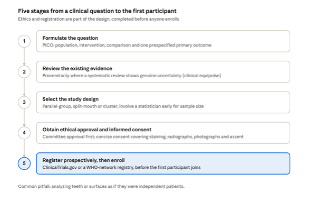
Figure 1: Five stages in planning a dental trial
1. Formulating the research question
The question is framed using PICO:
Population: children aged 3 to 5 years with active cavitated carious lesions
Intervention: 38% SDF applied twice yearly
Comparison: fluoride varnish, the current standard of care
Outcome: proportion of lesions arrested at 24 months
A single primary outcome, relevant to patients as well as clinicians, should be prespecified.
2. Reviewing the existing evidence
A systematic review should first confirm that the question is unresolved. A trial is ethically justified only where genuine uncertainty, or clinical equipoise, exists among experts (1).
3. Selecting the study design
Parallel-group: each participant receives one intervention; the conventional design.
Split-mouth: interventions are allocated to different sides of the mouth. The design is efficient but valid only where carry-over between sides is unlikely, which rules out many topical fluoride agents.
Cluster: schools or clinics are randomized; suited to community programs but requires larger samples.
Early statistical input sets the sample size and avoids a classic error: analyzing teeth as if they were independent patients.
4. Ethical approval and informed consent
An independent ethics committee must approve the trial before enrollment, in line with the Declaration of Helsinki (2) and Good Clinical Practice guidance (3). Consent needs particular care: a meta-analysis of 103 studies found that only about half (52.1%) of trial participants understood randomization (4). Consent forms should be short and plain, and should cover risks specific to dentistry, such as irreversible procedures, SDF staining, additional radiographs and clinical photographs. Children should give assent where developmentally appropriate, alongside parental consent.
Ethical and consent considerations are integral to trial design, not administrative steps that follow it.
5. Prospective registration
The trial is registered on a public registry, such as ClinicalTrials.gov, before the first participant enrolls. Registration is a public promise: it fixes the question, design and primary outcome in advance. Many medical journals will not publish a trial without prospective registration (5).
At the chair: Your clinical frustrations are research questions in disguise. Try writing one down this week in PICO form.
In Part 3, we turn from planning trials to reading them, and to the journey a result takes before it changes what happens in your operatory.
Key points
A trial begins with a precisely specified PICO question that existing evidence has not resolved.
Study design should match the question, with statistical input from the outset.
Consent materials should be concise and address dental-specific risks.
Prospective registration is required before enrollment.
References:
Freedman B. Equipoise and the ethics of clinical research. N Engl J Med. 1987;317(3):141-5.
World Medical Association. Declaration of Helsinki: ethical principles for medical research involving human participants. JAMA. 2025;333(1):71-4.
International Council for Harmonisation. Guideline for good clinical practice E6(R3). Geneva: ICH; 2025.
Tam NT, Huy NT, Thoa LTB, Long NP, Trang NTH, Hirayama K, et al. Participants’ understanding of informed consent in clinical trials over three decades: systematic review and meta-analysis. Bull World Health Organ. 2015;93(3):186-98H.
De Angelis C, Drazen JM, Frizelle FA, Haug C, Hoey J, Horton R, et al. Clinical trial registration: a statement from the International Committee of Medical Journal Editors. N Engl J Med. 2004;351(12):1250-1.