

Inside Dental Clinical Trials: Why Dentistry Needs Trials | Part 1 of 3 | A three-part blog series to close out 2026
Authored by: Prajakta D. | Clinical Research Coordinator, University Health Network (UHN), Toronto; Founder, DHI Trialists Inc.
Part 1: Why Dentistry Needs Trials
Nov 13, 2026, 12:00 ET: An examination of the evidence gap in oral health research and its implications for clinical practice.
The scenario below is illustrative, drawn from common clinical situations rather than a specific case.
It is a Tuesday afternoon, and a parent asks a simple question: why does her daughter's fluoride varnish come every six months, rather than every three or every twelve? The clinician answers with confidence, because six months is what everyone does. Yet behind that confident answer lies a surprisingly thin layer of trial evidence. Much of everyday dentistry rests on convention, laboratory data and expert consensus rather than on fair comparisons in patients. This first post asks why, and why it matters. Defining the clinical trial
A clinical trial is, at heart, a fair test. Investigators assign participants to an intervention, such as a material, procedure or preventive program, and measure what happens. In a randomized controlled trial (RCT), a coin toss, in effect, decides who receives what. Because chance rather than the clinician's judgment sets the groups, they start out alike, and any difference at the end can be attributed to the intervention rather than to who was chosen for it. Every trial follows a written protocol, is approved by an independent ethics committee, and should be registered before the first patient is enrolled (Figure 1).
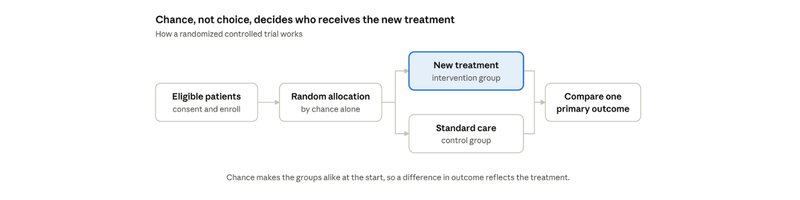
Figure 1: How a randomized controlled trial allocates participants
Why dental trials are comparatively scarce
If trials are so valuable, why does dentistry run so few of them? The answer is not a lack of curiosity among clinicians but a set of structural barriers, several of which a medical colleague rarely faces:
Funding: The National Institute of Dental and Craniofacial Research (NIDCR) received approximately $525 million in fiscal year 2026, about 1% of the National Institutes of Health's total program level of approximately $47.5 billion (1, 2) (Figure 2).
Regulation: New drugs require pivotal trials, which cost a median of about $19 million each (3). Many dental materials and devices reach the market through the FDA 510(k) pathway by demonstrating substantial equivalence to an existing product, often without new clinical trials (4).
Practice setting: Most dental care is delivered in private practices without research infrastructure, where time devoted to research is unreimbursed chair time.
Research workforce: Comparatively few dentists receive formal research training, which limits the number of investigators able to lead trials.
Disease characteristics: Restorative and surgical procedures are difficult to blind, and caries and periodontal disease progress slowly, so meaningful outcomes may take years to observe.
Even when dental trials are run, their results do not always reach readers. Fewer than one in four (23%) randomized trials published in a sample of oral health journals were registered (5), and only about half (51%) of completed trials on periodontal, implant and related topics registered on ClinicalTrials.gov have been published (6). The rest sit in what researchers call the file drawer: data that patients volunteered to provide, but that no clinician will ever read.
Oral diseases affect about 3.5 billion people worldwide. The National Institute of Dental and Craniofacial Research receives about 1% of the NIH budget.

Figure 2: NIDCR’s share of NIH funding
The picture is not all bleak. When dentistry has invested in rigorous trials, the payoff has reached every operatory. Fluoride varnish is the classic example. Trials synthesized in a Cochrane review showed reductions of about 43% (95% CI 30% to 57%) in decayed, missing and filled surfaces in permanent teeth and about 37% (95% CI 24% to 51%) in primary teeth (7). A procedure that takes minutes became a cornerstone of prevention because the evidence was clear.
A more recent story comes from New York City. The CariedAway trial took prevention out of the clinic and into schools, enrolling 2,998 children. It found that silver diamine fluoride (SDF) with fluoride varnish was non-inferior to glass ionomer sealants and atraumatic restorations with fluoride varnish for caries arrest and prevention (8). For children who may rarely sit in a dental chair, that finding is more than a statistic: it is a realistic route to care.
With oral diseases affecting about 3.5 billion people worldwide (9), dentistry cannot afford to rely on habit. Every routine we follow is, in effect, a hypothesis until a trial has tested it.
At the chair: Pick one procedure you performed this week. Could you name the trial that supports it? If not, you may have found a research question.
In Part 2, we follow one such question from the chairside to a fully planned trial.
Key points:
A randomized controlled trial allocates participants by chance, so that differences in outcome can be attributed to the intervention.
Limited funding, regulatory pathways, practice settings, the research workforce and slowly progressing diseases all constrain dental trials.
Trials of fluoride varnish and SDF show how rigorous evidence can change practice.
References:
Congressional Research Service. National Institutes of Health (NIH) funding: FY1996-FY2026. Report R43341. Washington (DC): CRS; 2026. Table 2, National Institutes of Health Funding, FY2024-FY2026 (FY2026 Enacted column). Available from: https://www.congress.gov/crs-product/R43341
Congressional Record. Daily ed. 2026 Jan 22;172(15 Book II):H1637-H1639. Source of FY2026 enacted NIH appropriations, as cited in reference 1.
Moore TJ, Zhang H, Anderson G, Alexander GC. Estimated costs of pivotal trials for novel therapeutic agents approved by the US Food and Drug Administration, 2015-2016. JAMA Intern Med. 2018;178(11):1451-7.
US Food and Drug Administration. Premarket notification 510(k) [Internet]. Silver Spring (MD): FDA [cited 2026 Nov 9]. Available from: https://www.fda.gov/medical-devices/premarket-submissions-selecting-and-preparing-correct-submission/premarket-notification-510k
Smaïl-Faugeron V, Fron-Chabouis H, Durieux P. Clinical trial registration in oral health journals. J Dent Res. 2015;94(3 Suppl):8S-13S. doi:10.1177/0022034514552492
Tomack J, Mascardo K, Chen CY, Chen T, Li X, Kim DM, et al. Clinical trials gone missing: a potential source for publication bias in dentistry. Publications. 2024;12(3):23.
Marinho VCC, Worthington HV, Walsh T, Clarkson JE. Fluoride varnishes for preventing dental caries in children and adolescents. Cochrane Database Syst Rev. 2013;(7):CD002279.
Ruff RR, Barry-Godin T, Niederman R. Effect of silver diamine fluoride on caries arrest and prevention: the CariedAway school-based randomized clinical trial. JAMA Netw Open. 2023;6(2):e2255458.
World Health Organization. Global oral health status report: towards universal health coverage for oral health by 2030. Geneva: WHO; 2022.